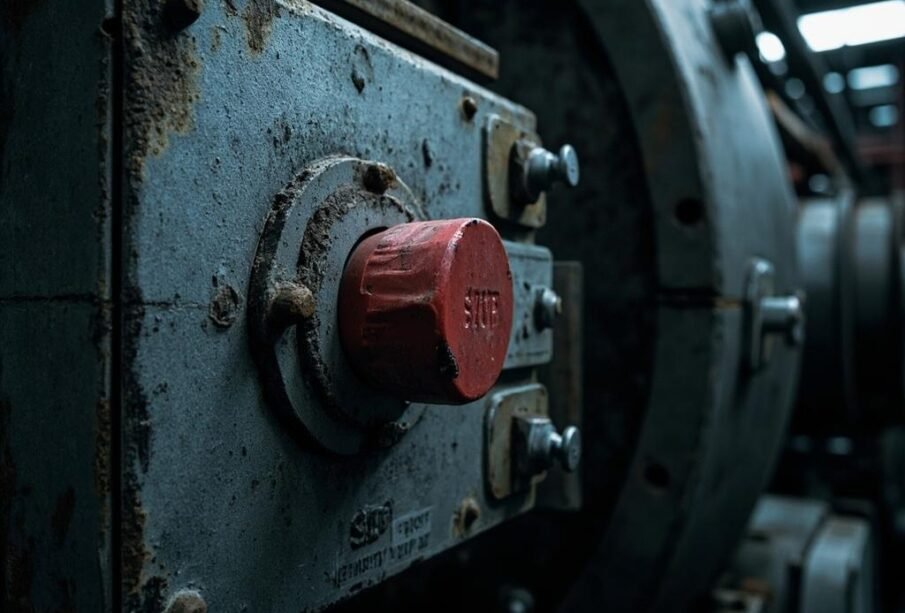
In industrial automation and machinery safety, two critical concepts often cause confusion among engineers, plant managers, and safety professionals: Emergency Stop (E-Stop) and Safe Torque Off (STO). While both safety functions aim to protect personnel and equipment from hazardous situations, they serve distinct purposes and operate through fundamentally different mechanisms. Understanding the key differences between these safety systems is essential for designing compliant machinery, maintaining workplace safety, and ensuring regulatory adherence. This comprehensive guide breaks down everything you need to know about Emergency Stop versus Safe Torque Off, from their operational principles to their specific applications across various industries.
What Is an Emergency Stop (E-Stop) System?
An Emergency Stop system is a manually operated safety device designed to immediately halt machinery operations in emergency situations. E-Stop buttons are typically red mushroom-headed switches with yellow backgrounds, mandated by safety regulations across virtually all industrial environments. When activated, an E-Stop initiates a complete shutdown of machine power, bringing rotating components to a standstill through mechanical braking or power disconnection.
The primary purpose of an Emergency Stop is to prevent injury to personnel who may be in immediate danger from moving machinery. E-Stop systems are required to be accessible within reach of operators and must provide foolproof operation even under stress. These systems operate by removing power from motor drives, activating mechanical brakes, or triggering safety clutches that disengage power transmission.
Key Characteristics of Emergency Stop
- Manual operation: Requires human intervention to activate, typically through a physical button press
- Immediate power removal: Cuts electrical power to motors and drive systems instantly
- Mechanical stopping: Often incorporates mechanical brakes for rapid deceleration
- Visual identification: Must be clearly marked with standardized colors (red/yellow) per ISO 13850
- Reset required: After activation, manual reset is necessary before machine restart
- Not for routine stopping: Designated exclusively for emergency situations, not normal process control
What Is Safe Torque Off (STO)?
Safe Torque Off (STO) is a functional safety function defined in IEC 61800-5-2 that prevents the generation of motor torque without necessarily removing power from the drive system. Unlike Emergency Stop, STO is typically an automated or integrated safety function within variable frequency drives (VFDs) and servo controllers. When STO is activated, the drive ceases producing torque, allowing moving parts to coast to a stop or be brought to rest by external braking mechanisms.
STO is classified as a Safety Integrity Level 3 (SIL3) or Performance Level e (PLe) function under modern safety standards, making it suitable for high-risk applications where torque removal alone provides adequate hazard control. This function is particularly valuable in automated systems where gradual, controlled stopping is acceptable and immediate mechanical braking would cause excessive wear or product damage.
Key Characteristics of Safe Torque Off
- Electronic control: Implemented through safety-rated circuits within motor drives
- Torque elimination: Stops torque production while maintaining drive readiness
- Controlled coast-down: Allows mechanical systems to decelerate naturally or via braking
- Part of safety system: Integrates with PLCs, safety relays, and safety light curtains
- Certification required: Must meet IEC 61800-5-2 and IEC 62061 / ISO 13849 standards
- No mechanical wear: Reduces stress on mechanical braking components
⚠️ Important Safety Warning:
STO alone does not provide protection against hazardous movement caused by gravity, external forces, or stored mechanical energy. Always conduct a thorough risk assessment per ISO 12100 to determine whether STO alone is sufficient or if additional safety functions like SS1 (Safe Stop 1) or mechanical brakes are required. Failure to properly assess hazards may result in serious injury or death.
Emergency Stop vs. Safe Torque Off: Direct Comparison
To fully understand the distinctions between these two safety mechanisms, consider the following comprehensive comparison table that outlines their fundamental differences across multiple dimensions.
| Aspect |
Emergency Stop (E-Stop) |
Safe Torque Off (STO) |
| Activation Method |
Manual push button |
Electronic/semi-automatic via safety circuit |
| Primary Function |
Remove all power, apply mechanical brake |
Eliminate motor torque output |
| Stopping Method |
Immediate forced stop with braking |
Controlled coast-down or gentle braking |
| Safety Standard |
ISO 13850, IEC 60204-1 |
IEC 61800-5-2, IEC 62061, ISO 13849 |
| Power State |
Complete power disconnection |
Drive remains powered (no torque) |
| Restart Capability |
Requires manual reset after power restoration |
Automatic restart once STO is deactivated |
| Mechanical Wear |
High stress on brakes and clutches |
Minimal mechanical stress |
| Response Time |
Milliseconds (immediate) |
Milliseconds (electronic response) |
| Application Focus |
Personnel protection during emergencies |
Process safety and controlled hazard mitigation |
| Cost Implications |
Lower initial cost, higher maintenance |
Higher initial cost, lower maintenance |
When to Use Emergency Stop Systems
Emergency Stop systems are mandatory safety components in virtually all industrial machinery according to international safety regulations. The selection of E-Stop as your primary or supplementary safety measure is appropriate in numerous scenarios where immediate, complete machine shutdown is essential for personnel protection.
Ideal Applications for E-Stop