In today’s highly competitive manufacturing landscape, minimizing downtime is not just an operational goal—it’s a strategic imperative. Changeover time, the period required to switch a production line from manufacturing one product to another, directly impacts throughput, profitability, and customer satisfaction. When changeover times are excessive, manufacturers face delayed deliveries, increased labor costs, and wasted capacity. Fortunately, manufacturing automation has emerged as a game-changing solution, enabling companies to dramatically reduce changeover intervals while maintaining quality and consistency. This article explores proven strategies, technologies, and best practices for reducing changeover time through automation, helping you optimize your production processes and stay ahead in an increasingly demanding market.
Understanding Changeover Time in Manufacturing
Changeover time encompasses all activities necessary to transition equipment from producing one product variant to another. This includes cleaning, reconfiguring, adjusting settings, loading new materials, and testing the equipment to ensure it operates correctly. Traditional changeovers often involve manual intervention, extensive trial-and-error adjustments, and significant waiting periods, resulting in hours of lost production time.
The financial impact of prolonged changeovers extends beyond immediate lost production. Organizations experience higher labor costs, increased risk of human error, inconsistent product quality, and reduced equipment lifespan due to frequent manual handling. Understanding these costs underscores the importance of implementing systematic approaches to changeover reduction.
The SMED Methodology: A Foundation for Changeover Excellence
Single-Minute Exchange of Dies (SMED) is a systematic methodology developed by Shigeo Shingo that has revolutionized changeover reduction efforts worldwide. The core principle of SMED involves converting internal changeover tasks (performed while equipment is stopped) into external tasks (performed while equipment is running) and streamlining all activities to minimize downtime.
Key SMED Principles Applied to Automation
- Separation of internal and external elements: Automation systems enable continuous preparation while production continues, eliminating idle time during transitions.
- Conversion of internal to external tasks: Automated tool positioning and recipe management allow pre-loading configurations before production stops.
- Streamlining of all operations: Robotic systems and programmable logic controllers (PLCs) execute complex sequences faster and more accurately than manual processes.
- Standardization of processes: Automated changeover protocols ensure consistent execution across shifts and equipment.
Automation Technologies That Reduce Changeover Time
1. Robotic Automation Systems
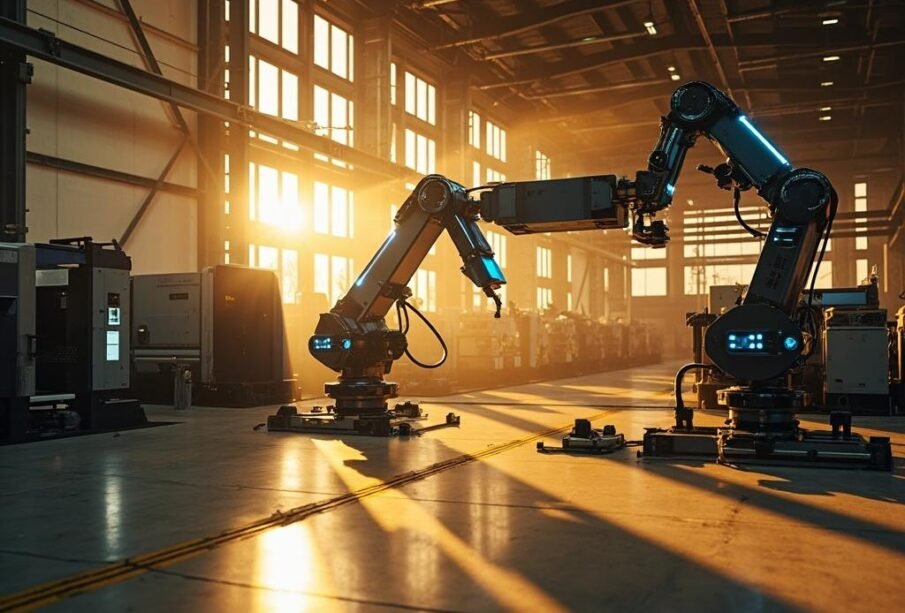
Industrial robots and collaborative robots (cobots) have transformed changeover operations by performing repetitive tasks with precision and speed. Robotic arms can automatically swap tooling, adjust grippers, and reposition components according to programmed sequences. These systems significantly reduce the physical labor involved in changeovers while eliminating variability caused by human factors.
2. Quick-Change Tooling and Fixtures
Modern quick-release mechanisms, magnetic clamping systems, and modular tooling designs enable rapid tool changes without specialized equipment. When integrated with automated positioning systems, these technologies allow tool swaps in minutes rather than hours, dramatically reducing changeover intervals.
3. Computer Numerical Control (CNC) Automation
CNC machines equipped with automated tool changers and preset tool magazines can switch between different machining programs instantaneously. Modern CNC systems store complete process parameters digitally, enabling instant reconfiguration for different product specifications without manual input or adjustment.
4. Automated Material Handling
Conveyor systems, automated guided vehicles (AGVs), and robotic part handlers eliminate the need for manual material loading and positioning. These systems can automatically deliver the correct materials, components, and packaging to production equipment based on the product recipe, ensuring seamless transitions between product runs.
💡 Key Insight: Companies implementing comprehensive automation for changeover reduction typically achieve 50-80% reduction in changeover time. However, success requires careful planning, employee training, and systematic process redesign—not merely purchasing new equipment. Technology alone cannot deliver results without aligned operational practices and organizational commitment.
Software and Control Systems for Changeover Management
Beyond physical automation, software systems play a critical role in coordinating changeover activities, storing process knowledge, and ensuring seamless transitions. Modern manufacturing execution systems (MES) and enterprise resource planning (ERP) platforms offer integrated changeover management capabilities that significantly enhance operational efficiency.
Recipe Management Systems
Digital recipe management enables operators to store, retrieve, and automatically apply complete process parameters for each product variant. Instead of manually adjusting dozens of settings, operators simply select the desired recipe from an intuitive interface, and automated systems configure all equipment accordingly. This eliminates configuration errors and dramatically accelerates changeover completion.
Real-Time Monitoring and Diagnostics
Advanced sensors and Internet of Things (IoT) connectivity provide real-time visibility into equipment status, process parameters, and changeover progress. Operators can monitor conditions remotely, identify potential issues before they cause delays, and access troubleshooting guidance automatically. This predictive capability prevents unexpected downtime and ensures consistent changeover performance.
Comparative Analysis: Traditional vs. Automated Changeover
To fully appreciate the impact of automation, consider the following comparison between traditional and automated changeover approaches:
| Metric |
Traditional Changeover |
Automated Changeover |
| Average Duration |
2-8 hours |
15-45 minutes |
| Human Intervention |
Extensive manual labor |
Minimal supervisory role |
| Error Rate |
High (5-15%) |
Very Low (<1%) |
| Consistency |
Variable between operators |
Identical every time |
| Documentation |
Manual, often incomplete |
Automatic, comprehensive |
| Process Knowledge Retention |
Dependent on individuals |
Systematic, organization-wide |
Post Views: 16