
Teradyne Robotics (TR) is partnering with Honeywell to enhance automation solutions and promote their adoption within warehousing and logistics businesses striving to keep up with consumer goods demands. By combining Teradyne’s expertise in mobile and collaborative robots with Honeywell’s AI-powered Momentum warehouse execution system, the partnership aims to tackle the most pressing challenges in high-throughput environments—improving speed, scalability, and operational efficiency from end to end. This collaboration marks a significant step forward in automating complex workflows and meeting the rising demands of e-commerce fulfillment.
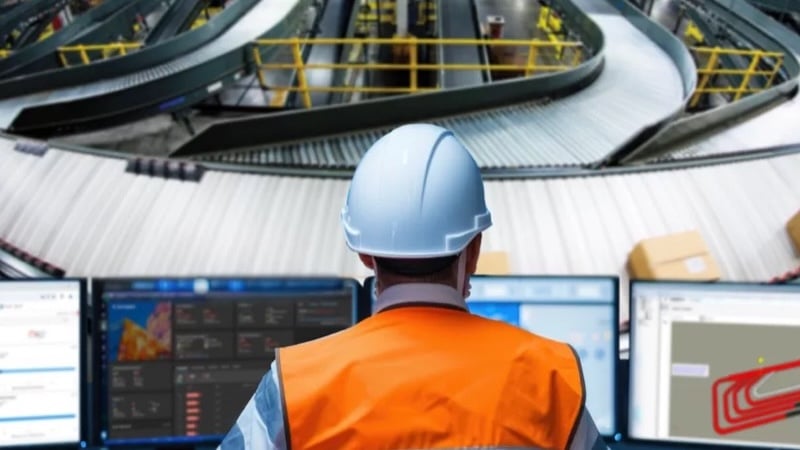
Honeywell and TR aim to promote the adoption of automated solutions across warehousing and logistics facilities, minimizing labor-intensive tasks, saving time, optimizing storage, inventory, management, and goods throughput. Image used courtesy of Honeywell
E-Commerce Growth Equals Adaptive Automated Solutions
With the post-COVID e-commerce boom and the convergence of e-commerce and AI, warehouse, logistics, and distribution centres worldwide have had to shift and adapt to cater to consumer demand for accessible online goods. Traditional, stagnant processes typically align with poor employee and workflow oversight, ineffective network communication across machines and control systems, a lack of suitable storage capacity, and the speed of order fulfilment operations.
Some of the trending technologies and systems that are driving evolution in warehousing and logistics environments include advanced autonomous mobile robots and automated storage and retrieval systems, such as Honeywell Intelligrated’s AS/RS shuttle solution.
Honeywell’s AS/RS is powered by the Momentum warehouse execution system (WES) alongside Decision Intelligence (DI) and the MC4 machine control (MC) platform. The system leverages machine learning to mine data and couple this with other operational insights to harness the power of Decision Intelligence for optimizing productivity during order fulfillment.
Modern agile warehousing and logistics workflows incorporate automated machinery and software that facilitate product visibility, effective inventory management, employee shift management, robotic fleet management, and efficient material handling to ensure the rapid, streamlined flow and high-turnover of goods.
Honeywell’s Momentum Warehouse Execution Software
Honeywell’s Momentum WES orchestrates labor management, allocating work and ensuring maximal productivity. The WES also executes storage and pick path optimization to enhance storage and reduce travel/latency time. Reduced labor means lowered operational costs, while goods tracking and streamlined workflows ensure customer service level agreements are maintained. More dynamic and agile systems also mean that operations can be scaled up or down to suit customer demand and/or operational goals.
Momentum WES also incorporates Smart Routing, which uses Decision Intelligence to pass packed goods (orders) via the most expedient path. The system routes orders to maximise speed and reduce bottlenecks, all the while handling order priority.
Smart Release is another feature of Honeywell’s WES that prioritizes backlogged orders, releasing them in a sequence that maximizes order fulfillment and satisfies urgent service level agreements. This feature helps warehouse and distribution center operators maintain order flow, reduce congestion, and maintain throughput.
An overview of the advanced capacities and benefits of ASRS for warehousing and logistics operations. Video used courtesy of Honeywell
Teradyne and Honeywell
Honeywell and TR are working together to offer complete, end-to-end automation products for businesses involved in high-turnover consumer goods, warehousing, and logistics, especially in the United States and Europe. Through this partnership, Honeywell's sophisticated Momentum WES, vast implementation knowledge, and cybersecurity skills are combined with TR's proficiency in AMRs and robotic systems. By providing smooth, intelligent automation from development to maintenance, the goal is to assist companies in addressing time-consuming, inefficient material-handling issues, which will ultimately result in lower operating costs, more efficient workforce operations, increased throughput, and enhanced worker safety.
Honeywell’s Strategic Divisions
In other news, Honeywell has announced its intentions to segregate its business operations into three publicly listed companies: Honeywell Aerospace, Honeywell Automation, and the previously discussed Advanced Material spin-off.
This translates to a more focused approach for Honeywell's business expansion. Honeywell Automation will focus efforts on developing technologies to enhance building and industrial infrastructure, employing advanced AI-driven software and hardware technologies to promote automated operations (supporting digital transformation, energy security, and sustainability for global businesses). Honeywell Aerospace will develop into a pure-play supplier of aircraft systems and technologies, ready to meet the high demand in both defense and commercial sectors.
This division results from industrial conglomerates' tendency to streamline their organizational structures, which offers more financial mobility, more focused leadership teams and boards, and definitive investment profiles. As a result, each company will be able to maximize capital allocation, boost organic growth, and eventually provide shareholders with substantial long-term benefits, according to Honeywell's leadership. In the run-up to the business partitioning, the corporation also intends to keep making strategic purchases to strengthen each division.