
KUKA has introduced iiQKA.OS2 as a next-generation operating system designed to drive digital manufacturing forward. Combining a modern technology stack with the proven reliability of KUKA system software, iiQKA.OS2 delivers an advanced, customizable, and scalable platform for robot control, whether virtual or physical.
Built for the future of automation, iiQKA.OS2 includes a full virtual robot controller (VRC), enabling offline simulation, programming, and testing. Manufacturers can design, validate, and optimize robotic systems before any hardware deployment, dramatically reducing risks and costs.
Future-Proof Robotics Control
iiQKA.OS2 blends KUKA’s decades of robotics expertise with the latest web technologies, offering a unified platform for all KUKA robots, ranging from their Delta and SCARA models to 6-axis robots across all payload classes. The system currently only supports small robots, with large robot compatibility expected to follow later this year.
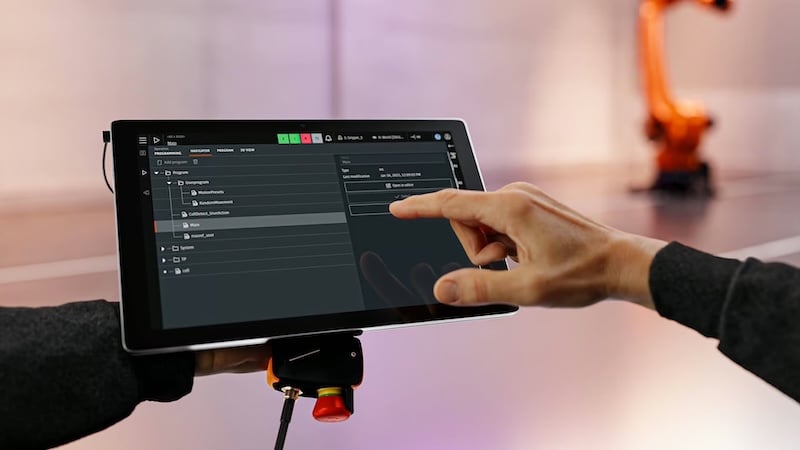
With the KUKA smartPLUG, programmers can use the iiQKA.UI web-based software to program their systems rather than using the typical smartPAD. Image used courtesy of KUKA
Featuring a flexible “use your own device” option, iiQKA.OS2 allows users to connect to any tablet by using the KUKA smartPLUG or the familiar KUKA smartPAD. Combined with the web-based iiQKA.UI, operators can intuitively set up and control systems without the need for specialized hardware.
The system is fully prepared for the upcoming ISO 10218:2025 standard and the new machinery regulation (MachReg), ensuring long-term compliance and security.
Integrated Engineering with iiQWorks
Central to iiQKA.OS2 is the iiQWorks engineering suite that provides a comprehensive toolkit for simulation, offline programming, fieldbus integration, and robotic cell management. iiQWorks supports advanced features such as load data analysis with KUKA. Load safe area configuration in 3D environments, and statement-based KRL programming for easier code development.
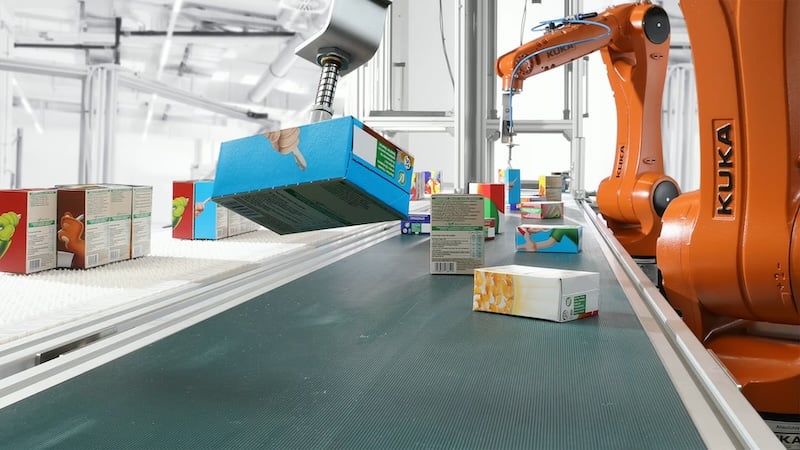
Multiple KUKA robot kinematics can be operated from the same system as long as the KR C5 standard or KR C5 microcontroller is used with iiQKA.OS2 is loaded. Image used courtesy of KUKA
The platform enables users to simulate multiple robots and peripherals simultaneously, significantly reducing commissioning time and cost. You will also be able to utilize fieldbus communications such as PROFINET, EtherCAT, DeviceNet, and other protocols. This gives manufacturers the flexibility needed to design automation systems that will be tailored to their infrastructure.
Cybersecurity, Modularity, and Expandability
Built on a Linux-based architecture, iiQKA.OS2 offers cyber resilience certified to IEC 62443 standards. Optional NVIDIA-powered AI modules are available to add machine vision and advanced AI capabilities, enhancing system intelligence.
The platform’s modular design allows for customer-specific software packages and workflow customizations using iiQWorks.OptionPackageEditor. Whether for small, medium, or OEM-sized operations, iiQKA.OS2 scales with evolving production needs while maintaining reliability and security. KUKA’s expanding ecosystem ensures iiQKA.OS2 users can access various solutions and partners to optimize their manufacturing environments further.
IiQKA.OS2 is creating the foundation for the next generation of robotic programming of automated manufacturing. Combining the power of virtual simulation, flexible deployment, and future-ready compliance, KUKA has given its customers a platform that reduces risks, accelerates production timelines, and drives long-term success.