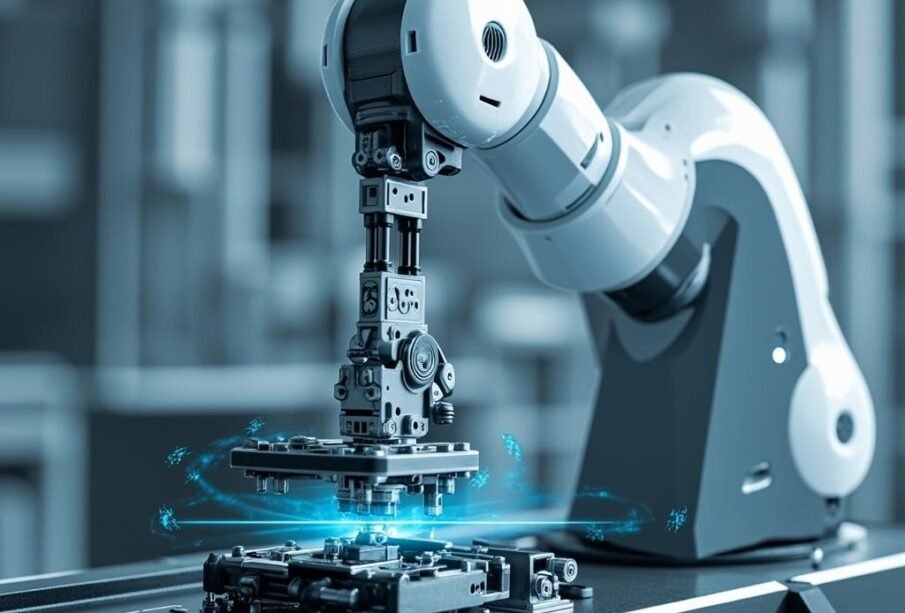
In modern manufacturing environments, precision and reliability are paramount. Assembly robots have revolutionized production lines by delivering unmatched speed, accuracy, and consistency. However, traditional position-based robotic systems often struggle with tasks requiring delicate handling, tight tolerances, or interaction with unpredictable environments. This limitation gave rise to force control in assembly robots—a sophisticated technology that enables machines to sense, adapt, and respond to physical interactions in real time. From inserting microelectronic components onto circuit boards to assembling automotive powertrains with sub-millimeter precision, force control has become an essential capability for achieving flawless assembly operations across industries.
Understanding Force Control: Definition and Core Concepts
Force control refers to the ability of a robotic system to regulate the contact forces exerted during interaction with objects and environments. Unlike conventional position control, where robots follow predetermined trajectories regardless of resistance, force-controlled robots modulate their movements based on real-time feedback from force and torque sensors. This allows the robot to maintain specific force profiles, comply with environmental constraints, and adapt to variations in part geometry, alignment, and material properties.
The fundamental principle behind force control involves closed-loop feedback systems. When a robot performs an assembly task, sensors continuously measure the forces and torques at the end-effector. These measurements are compared against desired reference values, and any deviation triggers corrective actions in the robot’s control system. This continuous adjustment ensures that the applied force remains within specified limits, preventing damage to delicate components while still providing sufficient insertion or mating forces.
Types of Force Control Strategies
Industrial applications employ several distinct force control methodologies, each suited to specific task requirements and complexity levels. Understanding these strategies is crucial for selecting the appropriate approach for your assembly application.
Direct Force Control
Direct force control is the most straightforward approach, where the system directly regulates the contact force to match a desired setpoint. The controller adjusts the robot’s position or velocity to minimize the error between measured and target forces. This method provides excellent force tracking accuracy and is ideal for tasks requiring constant force application, such as polishing, grinding, or pressing operations.
Impedance Control
Impedance control establishes a dynamic relationship between force and motion rather than directly controlling either variable. The robot behaves as if it possesses mechanical impedance—either stiffness, damping, or mass characteristics—that can be programmed. This approach excels in tasks involving contact transitions, such as moving from free space to constrained environments, because the robot naturally adapts its behavior based on environmental interactions.
Hybrid Position/Force Control
As the name suggests, hybrid position/force control simultaneously regulates both position and force along different task directions. For example, during a peg-in-hole insertion, the robot might control position along the insertion axis while controlling force in the lateral directions. This strategy is particularly valuable for assembly tasks with mixed constraints.
Adaptive Force Control
Adaptive force control employs advanced algorithms that automatically adjust control parameters based on changing conditions. Machine learning techniques enable these systems to improve performance over time, making them suitable for complex assembly tasks with significant variability.
Key Components of Force-Controlled Assembly Systems
Implementing effective force control requires integration of several critical hardware and software components. Each element plays a vital role in achieving reliable and accurate force regulation.
Force/Torque Sensors
Force/torque sensors are the sensory foundation of any force-controlled system. These devices, typically mounted at the robot wrist or end-effector, measure forces and torques along multiple axes. Common types include six-axis load cells, single-axis load cells, and tactile sensor arrays. The sensor’s sensitivity, range, and bandwidth directly impact system performance.
Robot Controller
The robot controller serves as the computational brain, executing force control algorithms and managing real-time communication with sensors and actuators. Modern controllers feature dedicated processors for control computations and offer programmable logic for task sequencing and safety monitoring.
End-Effectors and Grippers
Specialized end-effectors designed for force-sensitive applications often incorporate integrated sensing, compliance mechanisms, and specialized gripper designs. These tools must transmit forces accurately while protecting delicate workpieces from damage.
Force Control in Assembly Applications
Force control technology enables assembly robots to perform a diverse range of tasks that would be impossible or impractical with position control alone. Below are the most significant applications transforming modern manufacturing.
- Peg-in-Hole Assembly: Inserting cylindrical components into holes with tight tolerances requires precise force regulation to overcome friction and misalignment without damaging parts.
- Electrical Connector Mating: Force control ensures proper engagement of delicate pins and sockets in automotive, aerospace, and electronics assemblies.
- Screw Driving and Fastening: Regulating torque during threaded assembly prevents overtightening, stripping, or damage to components.
- Precision Press-Fitting: Bearings, seals, and other press-fit components require controlled insertion forces for reliable assembly.
- Wire Harness Routing: Force-controlled robots guide cables and harnesses through complex routing paths without damaging insulation.
- Electronic Component Placement: Placing sensitive microchips and surface-mount devices demands gentle handling with precise placement forces.
Industrial Applications by Sector
Force-controlled assembly robots serve diverse industries, each with unique requirements and operational challenges.
| Industry |
Typical Applications |
Force Requirements |
Benefits |
| Automotive |
Engine assembly, gearbox assembly, brake component mounting |
High (50-500 N) |
Consistent quality, reduced rework, faster cycle times |
| Electronics |
PCB assembly, connector mating, battery pack assembly |
Low (0.1-10 N) |
Protection of delicate components, precise placement |
| Aerospace |
Composite layup, fastener installation, turbine assembly |
Variable (5-200 N) |
Compliance with strict tolerances, reduced damage rates |
| Medical Devices |
Surgical instrument assembly, implant assembly, catheter production |
Very low (0.01-5 N) |
Sterile precision, quality documentation, traceability |
| Consumer Goods |
Appliance assembly, toy manufacturing, furniture assembly |
Medium (10-100 N) |
Flexibility for product variants, reduced labor costs |
Benefits of Implementing Force Control
Organizations implementing force control in their assembly operations experience substantial improvements across multiple performance dimensions.
- Enhanced Assembly Quality: Force control eliminates variability caused by part tolerance stack-ups, operator inconsistencies, and environmental factors. This results in higher first-pass yield rates and more consistent product quality.
- Reduced Component Damage: By precisely regulating insertion and mating forces, force control prevents costly damage to expensive or delicate components, reducing scrap rates and rework requirements.
- Improved Flexibility: Force-controlled robots can handle part variations and misalignments without manual intervention, supporting faster changeovers and greater product variety.
- Increased Throughput: Optimized force profiles enable faster cycle times by eliminating overly conservative approaches required in manual or non-force-controlled operations.
- Better Ergonomics and Safety: Automating high-force assembly tasks protects workers from repetitive strain injuries and reduces exposure to hazardous operations.
- Process Documentation: Force